Légende
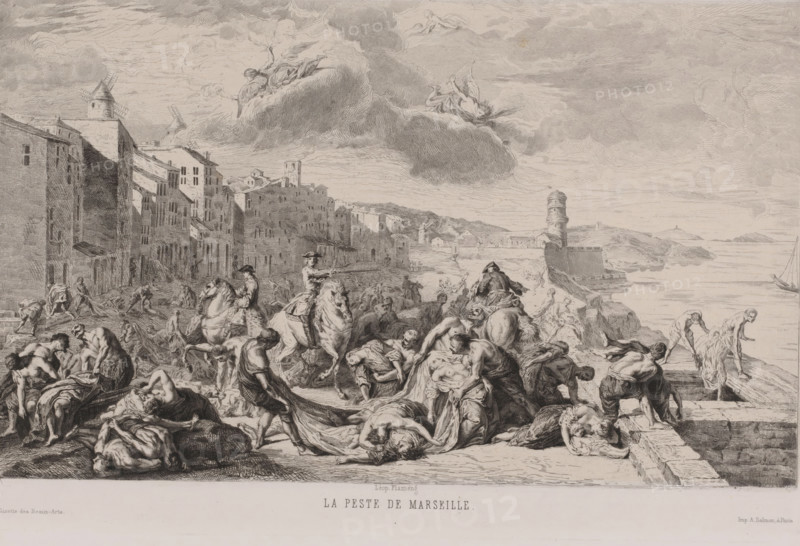
The Bully of Marseille, Victims of the bubonic plague are being disposed of in La Tourette, Marseille, print, In the La Tourette district, the bodies of the plague victims are being disposed of by galley rowers and soldiers under the leadership of Nicolas Roze (Chevalier Roze). Unfree laborers were primarily used on the galleys. Many of the rowers were Muslim galley slaves, recognizable as such by their ankle shackles and the typical hairstyle (head shaved bald except for a lock) that they were required to have. This distinguished them from, for example, political prisoners who had been sentenced to the galleys. The galley rowers who helped clear the plague victims in Marseille were promised freedom in return, but the majority of them succumbed to the disease themselves., printmaker: Léopold Flameng, after painting by Jean-François de Troy, printer (person): Alfred Salmon, Paris, 1860, printer (person), paper, chine collé, etching, height 210 mm x width 318 mm, Other state of print used in: Gazette des beaux-arts (1860), vol. 6, p. 158. Both states were also available separately., Person, Nicolas Roze, slavery, serfs and enslaved persons, harbour, quay, plague, plague - AA - plague epidemic, Islamic galley slaves, Provence-Alpes-Côte d'Azur, Period, 1720, A wide coastal scene rendered in fine monochrome lines shows a crowded quay with numerous human figures in various poses, many lying or being tended, others standing, lifting, or carrying draped bodies; two mounted riders in period dress sit astride horses near the center, and a uniformed figure on horseback gestures toward the crowd; on the left a row of tall, closely packed buildings rises toward windmills on higher ground, while a towered fortification and a cylindrical lighthouse-like structure stand near the water at the right; small boats and a distant shoreline appear
Crédit
Photo12/Liszt Collection
Notre référence
LZT26B17_312
Licence
Droits gérés
Format disponible
56.3Mo (6.9Mo) / 45.4cm x 31.0cm / 5367 x 3665 (300dpi)