Légende
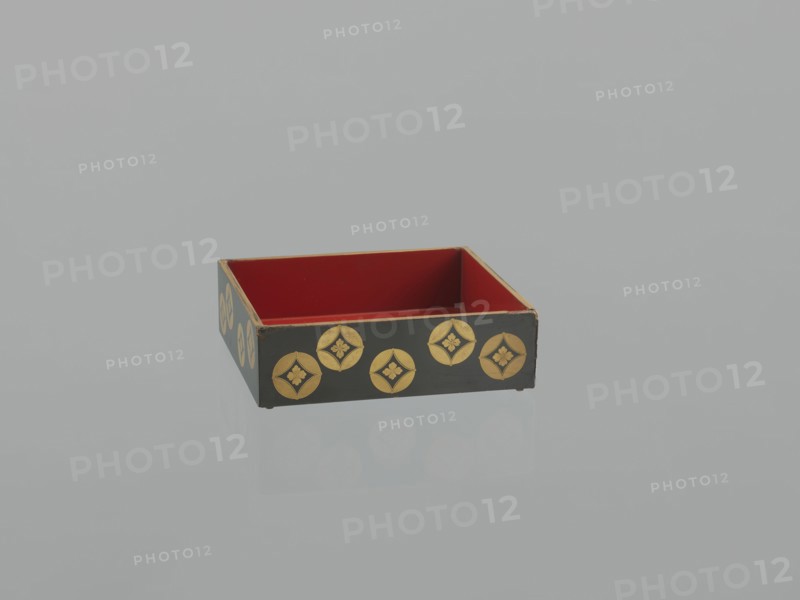
Portable picnic set sagejûbako, Rectangular cabinet without side walls. On a stand there are two food containers stacked on top of each other set incomplete; originally four; next to the containers on the stand are two tin sake bottles. The top tabletop, equipped with a handle, has one small drawer and a shelf for trays missing. Entire surface covered with black roiro-nuri lacquer; interiors of the food containers covered with vermilion lacquer. Ornament executed in hiramaki-e and nashiji techniques depicting blooming wisteria, camellias, rosettes coins, mon, leaves, plum trees, and wolfberries. Such portable eating sets were called variously in Japan kocho, sageju, hanami bento and were popular from the Momoyama period mid-16th–early 17th century, and in the 18th and 19th centuries. 19th century Edo–Meiji periods, Japan. Dimensions: height 31.3 cm, width 30.5 cm, depth 17.8 cm; weight 2.29 kg., A shallow rectangular box with an open top sits on a reflective surface; the interior is red and the exterior is black with a row of gold circular emblems on the visible sides, and the box shows some worn edges where the black meets the red.
Crédit
Photo12/Liszt Collection
Notre référence
LZT26A22_076
Licence
Droits gérés
Format disponible
77.2Mo (720.9Ko) / 50.8cm x 38.1cm / 6000 x 4500 (300dpi)