Légende
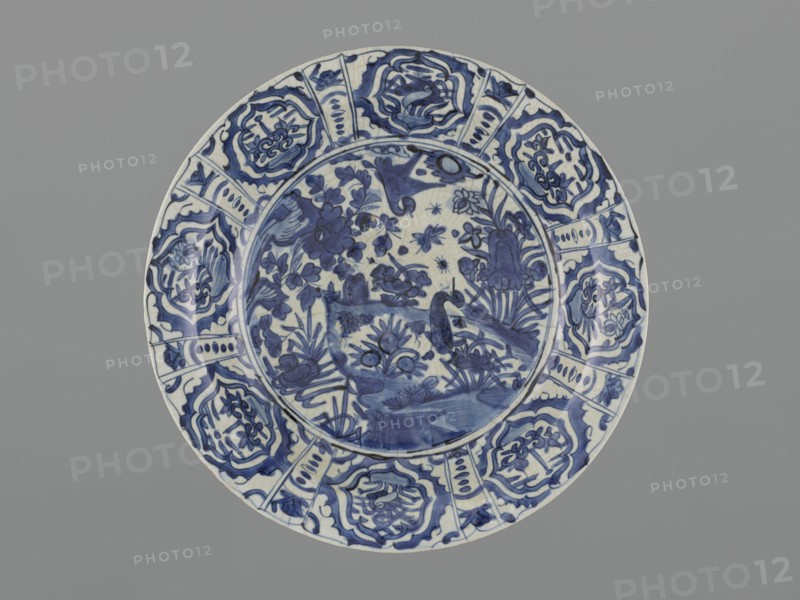
Platter, Safavid dynasty 1501–1736, Persian; ceramics, round deep platter with separate rim on a ring foot. Decoration: in the mirror a pond scene with rocks, three ducks and various aquatic plants and insects; on the collar in eight multi-leafed cartouches cranes and stylized plants; stylized plants on the outer side of the rim. On the reverse a handwritten inscription in Arabic script; within the ring of the foot the words jami'-je Bali handwritten in brown dye, likely referring to an unspecified locality. The asymmetric composition—central rock and a bank jutting into the water with a duck—maintains a circular form without horizontal landscape division. Decoration imitates motifs of blue-and-white Chinese kraak porcelain and alludes to Chinese painting, but Persian ceramic depictions are freer and denser in motifs; plant-animal compositions birds, insects, quadrupeds echo Persian textile and miniature traditions. Nature was a frequent Safavid subject; the first landscape compositions on Persian ceramics began in the 15th century under Chinese influence. Analogy: Kverfeld 1947, ill. XXX., 16th century, Azerbaijan, vessel, h. 9.2 cm, diam. 44.0 cm., A round ceramic plate with blue and white decoration sits against a gray background; the plate has a central circular scene filled with floral motifs, leaves, and birds rendered in deep blue on a white ground, surrounded by a wide border band divided into a repeating pattern of cartouches and panels containing stylized floral and foliate designs, all painted in varying shades of blue with visible brushwork and areas of darker and lighter blue wash, with the overall palette limited to blue, white, and the surrounding gray.
Crédit
Photo12/Liszt Collection
Notre référence
LZT26A22_041
Licence
Droits gérés
Format disponible
77.2Mo (2.1Mo) / 50.8cm x 38.1cm / 6000 x 4500 (300dpi)