Légende
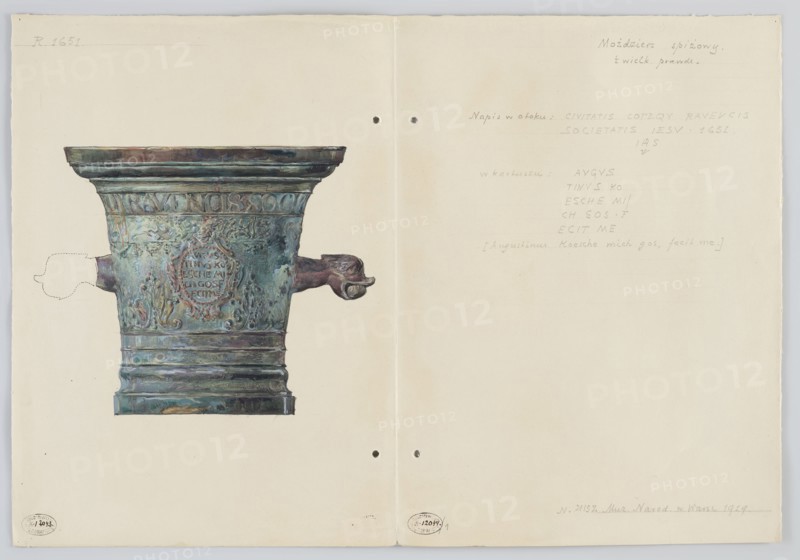
Bronze utility mortar originally from the Jesuit convent in Rawa, the work of bell founder Augustyn Koeschel from 1651 — view at 1:2 scale; drawing and watercolor, artistic documentation by Mieczyslaw Kotarbinski 1890–1943; ink/paint on card; height 35.8 cm, width 51.5 cm; mortars vessel, Jesuits order, 17th century; Rawa Mazowiecka, Warsaw., A painted depiction of a large metal mortar with a wide flared rim and a cylindrical body resting on a short base, shown against a light cream background; the mortar has ornate raised decoration and a central cartouche, and a broken handle on one side with the remaining handle shaped like a stylized animal head; colors visible include green, turquoise, blue, brown, coppery bronze, and hints of purple and rust on the metal, with shadowing in darker blues and grays.
Crédit
Photo12/Liszt Collection
Notre référence
LZT26A07_394
Licence
Droits gérés
Format disponible
72.2Mo (3.5Mo) / 50.8cm x 35.6cm / 6000 x 4204 (300dpi)