Légende
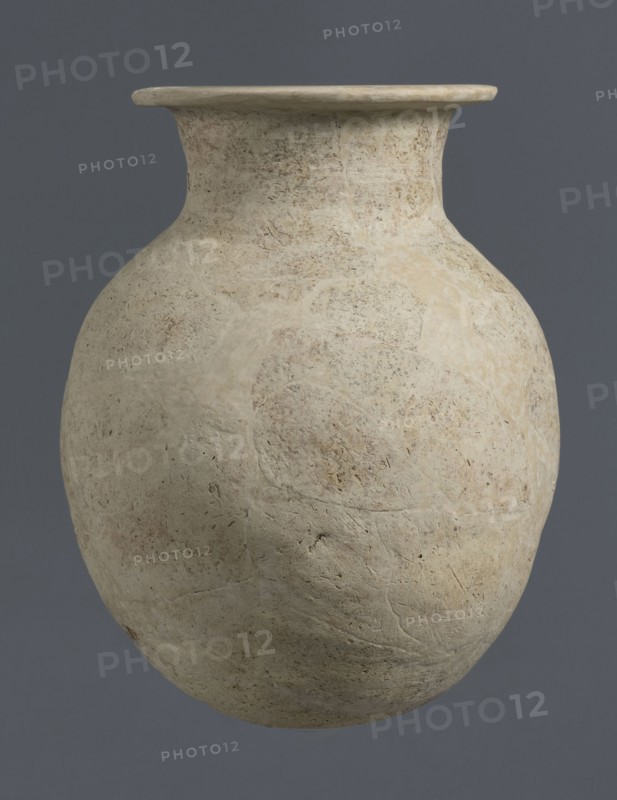
Vise-less jug, unknown northern Mesopotamian workshop; Early Jazira III period ca. 2600–ca. 2350 BC; clay; bulbous vessel — jug vise-less. Vise-less jug with an ovoid belly with a flat, crookedly cut round bottom, sloping shoulders, from which arises a high cylindrical neck terminating in a wide flat spout protruding outwards. Origin: Al-Jazira northern Mesopotamia, Khabur basin; discovered at Tell Rad Shakra, northeastern Syria., A large rounded vessel with a narrow neck and flared rim sits against a solid background; the vessel surface appears rough and weathered with an uneven texture and small pitting and scratches, showing a pale beige to off-white color with areas of light tan and faint gray mottling, while the background is a muted dark gray-blue.
Crédit
Photo12/Liszt Collection
Notre référence
LZT26A05_339
Licence
Droits gérés
Format disponible
79.5Mo (6.2Mo) / 39.2cm x 50.8cm / 4633 x 6000 (300dpi)