Légende
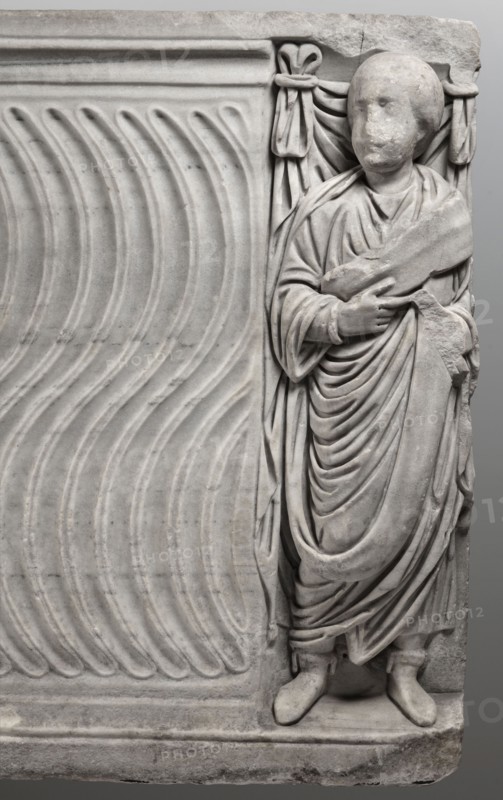
Sarcophagus with a depiction of a married couple and a shepherd, unknown Roman workshop. A large Roman sarcophagus with strigilla S-shaped grooves converging toward the center forming a central medallion, decorated with a standing, thoughtful shepherd leaning on a shepherd's staff pedum. On the front sides are figures presumed to be the deceased, standing before draped fabrics parapetasmata: on the left, a woman in a tunic and long cloak palla holding a scroll volumen in her left hand; on the right, a man in a tunic and toga with contabulatio specially wrapped hem, holding a scroll in his left hand and wearing mullei leather military boots. Both frontal figures have incompletely finished heads. The side walls show reliefs of a seated griffin with a lion's head; the left wall near its lower left corner has an opening into the interior, and the lower left corner of the right wall is missing. The rear wall is rather carelessly worked. Considerable abrasions and damage, particularly at the corners and to the figures on both sides of the front wall. Circa 270, Roman Empire 27 BC–476. Sarcophagus Roman. Height 100 cm, width 214 cm, depth 100 cm, weight 2400 kg., A carved stone relief showing a standing figure draped in flowing garments beside a textured panel. The figure appears to wear a long robe with layered folds and a wrapped cloth across the chest, with visible hands and feet; the head is rounded with subtle facial features. The panel next to the figure has a repeated curved groove pattern creating a wave-like texture. Decorative tied drapery elements frame the area behind the figure. The colors visible are shades of gray, off-white, and pale beige across the stone surface.
Crédit
Photo12/Liszt Collection
Notre référence
LZT26A05_241
Licence
Droits gérés
Format disponible
64.9Mo (5.6Mo) / 32.0cm x 50.8cm / 3778 x 6000 (300dpi)