Légende
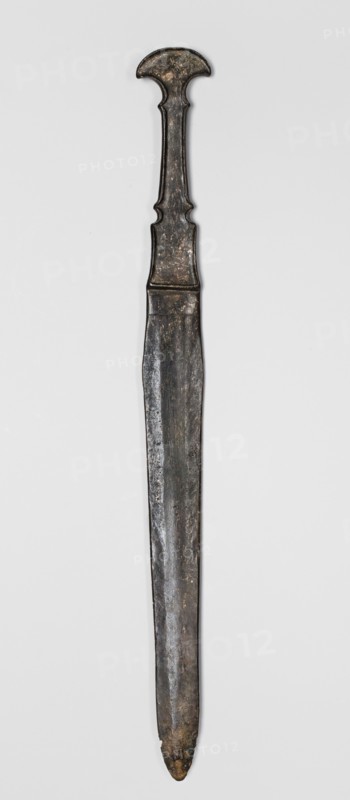
Dagger, unknown Luristan workshop. Dagger with a cast blade and a mushroom-shaped hilt with a rimmed mount; the raised edges of the mount served to hold a lost hilt casing, possibly of bone, wood, horn, or stone. The hilt shaft is richly profiled and flows directly into the blade with a centric point. Behind the short, rectangular base, blunted on both sides, the double-edged blade tapers evenly toward the tip. A slightly convex ridge runs through the center of the blade and splits along one-third of its length toward the base, creating a triangular flat field. 9th–6th century BC; Iron Period II 1st half of the 1st millennium BC. Luristan, Iran. Weapon. Height 33.8 cm; width 2.9 cm; depth 0.8 cm; weight 194 g., A long vertical metallic object with an elongated straight blade and a distinct handle at the top, displayed against a light gray background. The handle has a rounded top and a narrow neck with sculpted inward curves, showing an aged, slightly irregular surface. The blade is straight with subtle tapering toward the tip and visible surface texture variations including rough patches and small imperfections. The metal surface shows a range of dark gray and brown tones with areas of lighter gray and hints of greenish and yellowish discoloration consistent across the handle and blade. The overall shape is symmetrical along its length with a worn, slightly rough finish and a rounded tip that appears darker and more textured than the rest of the blade.
Crédit
Photo12/Liszt Collection
Notre référence
LZT26A04_308
Licence
Droits gérés
Format disponible
45.1Mo (2.1Mo) / 22.2cm x 50.8cm / 2626 x 6000 (300dpi)