Légende
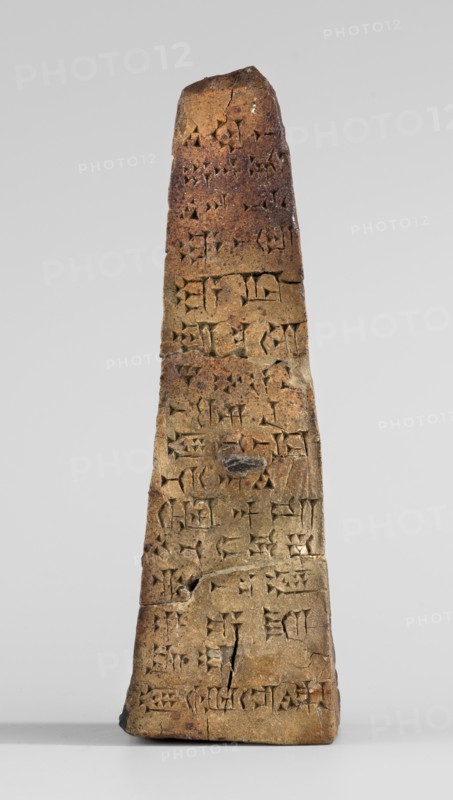
Votive obelisk with an inscription of King Ashurbanipal forgery with a copy of an ancient text, cuneiform writing, Ashurbanipal king of Assyria; ca. 668–ca. 631 BC, votive offering, obelisk, inscription, forgery. Clay votive obelisk tapering toward the top; cuneiform text inscribed on all four faces. Dating of copied inscription content: c. 668–c. 631 BC Neo-Assyrian period; object itself dated to 2nd half 19th century–1st half 20th century forgery. Inscription based on texts from Iraq Quyunjik, Nineveh. Document/dedication. Height 13.1 cm; width 3.7 cm; thickness 4.2 cm., A tall, narrow stone object with a tapered, roughly triangular silhouette standing upright on a flat surface, showing a textured, weathered surface with carved indentations across its face; the stone displays a range of colors including brown, tan, beige, and darker brown patches, with some small worn or chipped areas and visible hairline cracks, while the background is a smooth light gray.
Crédit
Photo12/Liszt Collection
Notre référence
LZT26A04_280
Licence
Droits gérés
Format disponible
35.1Mo (1.5Mo) / 22.3cm x 39.4cm / 2636 x 4653 (300dpi)