Légende
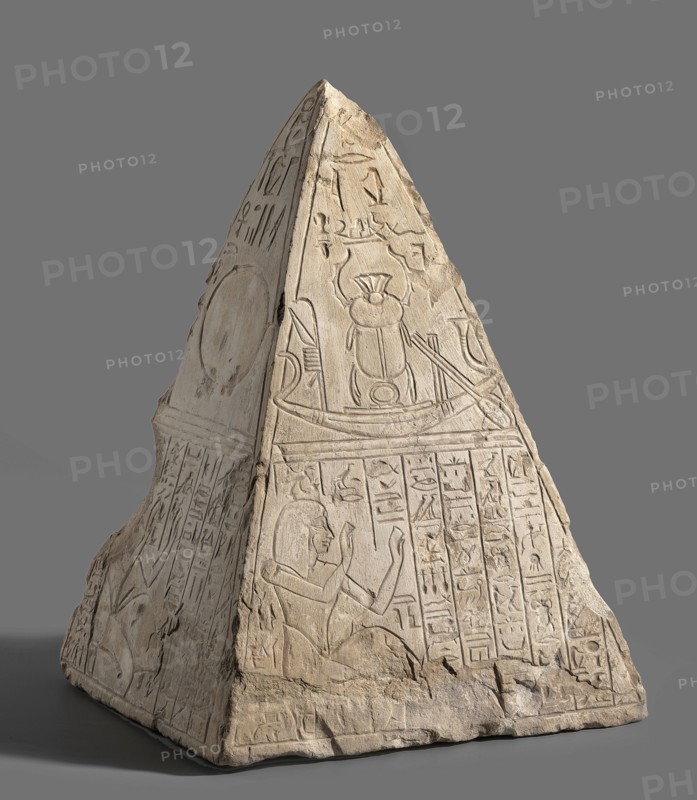
Pyramidion of a deceased named Paser and his father Turobai;, Paser ca. 1295–1186 BC and Turobai ca. 1295–1186 BC. Materials: stone architectural element; sepulchral funerary architecture; Egyptian, New Kingdom, 19th Dynasty reign of Ramesses II. Found at Deir el-Medina House no. 1312. Function: pyramidion. In the lower part Paser or his father Turobai are depicted crouching with both hands raised; surrounding free space filled with columns of hieroglyphic inscriptions. Upper register divided into four panels: I — the god Re with a human face in a sun barge; below, father or son. II — a sun barge with the Khepri scarab; below, father. III — the sign of the sun on the horizon; below, son. IV — the falcon-headed god Re with a disc on his head in a barge; below, father. Iconography includes Re, Khepri, boat, shen ring, wig, sun disc, ankh, and hieroglyphs. Dimensions: height 34.5 cm; width 25 cm; depth 23 cm; weight 16.5 kg., A carved stone pyramidion with a pointed top sits against a plain gray background; the stone is an off-white to beige color with areas of darker tan weathering and shadowed crevices. One visible face shows a seated human figure in profile with an outstretched arm, rendered in shallow relief, beside a panel filled with carved pictorial elements; above this is a carved representation of a beetle-like form within a boat motif. The adjacent face displays a circular recessed shape and linear carved motifs. The stone surface has rough, chipped edges and areas of erosion, and the base rests on a flat plane casting a soft shadow. The overall palette includes shades of beige, cream, tan, gray, and subtle brown.
Crédit
Photo12/Liszt Collection
Notre référence
LZT26A02_482
Licence
Droits gérés
Format disponible
53.4Mo (3.4Mo) / 34.1cm x 39.2cm / 4032 x 4627 (300dpi)