Légende
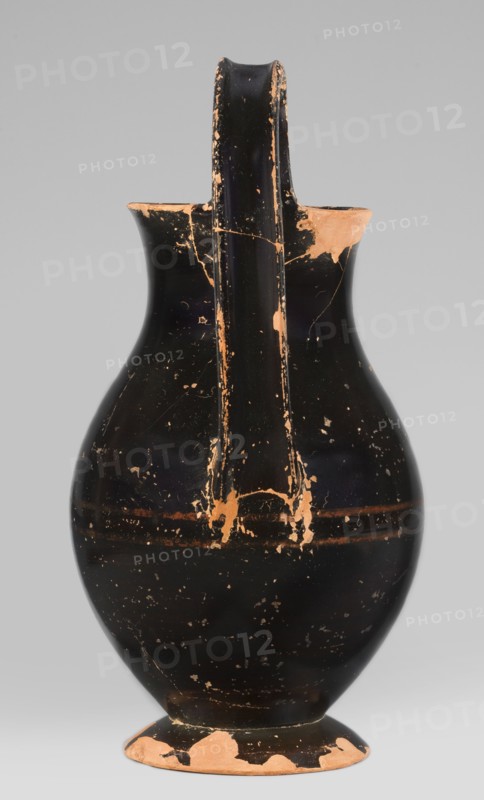
Olpe type of jug for liquids with inscription, unknown Attic workshop; Crito ca. 550–500 BC signature. Black-finished olpe with a clay-coloured cartouche at the point of maximum diameter bearing Crito's signature KRITONEPOIESEN, also reading LEPOSYS. Medium-sized olpe, rim edge slightly turned outwards; low neck gently transitioning into a concave, spherical belly, clearly distinguishable from the low conical foot with a recess. Bottom slightly convex. Profiled vise shaped with clearly distinguishable edges. On the inner side of the rim, two clay nodules one reconstructed are visible, located 4.5 cm apart on the side of the vise. 550–500 BC; Attica, Athens. Olpe vessel. Height 26 cm; width 13.5 cm; depth 15.5 cm; weight 0.58 kg., A single ceramic jug with a rounded body, narrow neck, and a tall handle rising from the rim to the shoulder, shown against a plain light gray background; the jug has a predominantly black surface with worn areas revealing a terracotta color, including chips and flaked spots across the body, handle, rim, and foot; the foot shows a banded edge with alternating black and exposed terracotta patches, and the handle and upper shoulder display visible wear where the black coating has peeled, creating irregular terracotta-colored lines and patches; the jug's shape tapers toward a narrow base and flares slightly at the rim, and the overall surface shows small scattered flecks and scratches in both black and terracotta tones.
Crédit
Photo12/Liszt Collection
Notre référence
LZT26A01_359
Licence
Droits gérés
Format disponible
50.6Mo (2.3Mo) / 27.7cm x 45.8cm / 3271 x 5405 (300dpi)