Légende
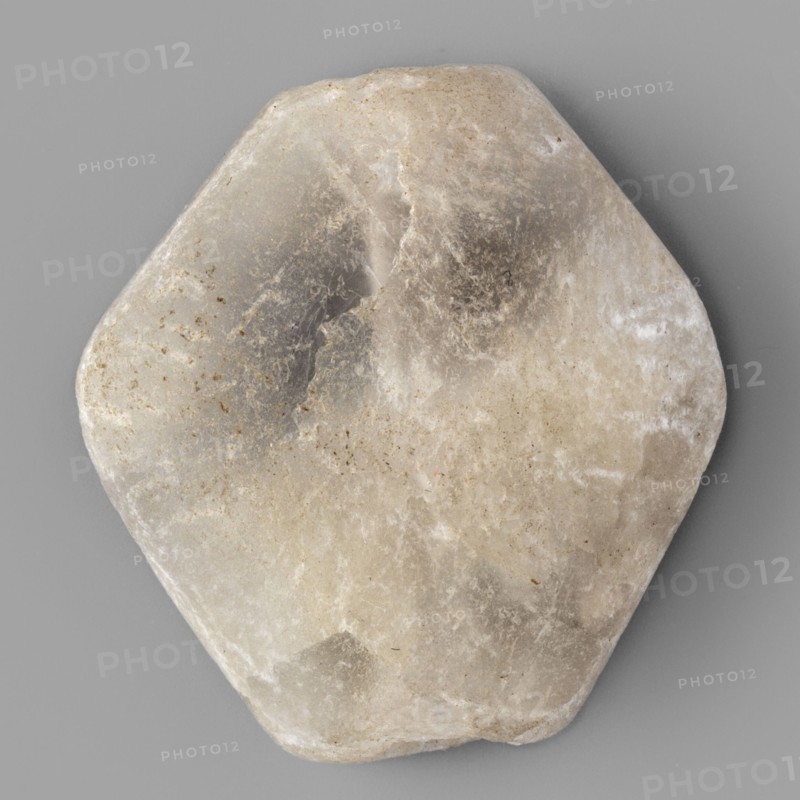
Rhomboid bead, unknown Northern Mesopotamian workshop; rhomboid bead with smooth surfaces, two corners cut off at the ends of the axis, with a drilled hole for stringing. 1st half of the 3rd millennium BC; Early Jazira III period Early Dynastic III; ca. 2600–ca. 2350 BC. Northern Mesopotamia Khabur basin; Tell Rad Shakra northeastern Syria. Found in children's graves. Height 2.2 cm; width 2.08 cm; depth 0.8 cm., A roughly hexagonal stone with rounded edges sits against a flat background; the stone shows a range of muted colors including off-white, beige, gray, and hints of brown, with areas of translucent milky white and darker gray patches, subtle speckles and streaks, and a slightly worn, uneven surface texture.
Crédit
Photo12/Liszt Collection
Notre référence
LZT26A01_122
Licence
Droits gérés
Format disponible
17.5Mo (1.1Mo) / 21.0cm x 21.0cm / 2476 x 2476 (300dpi)