Légende
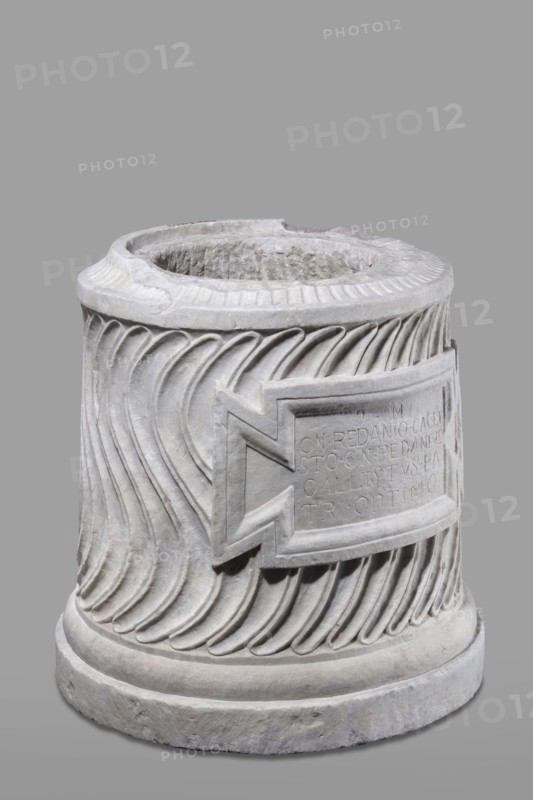
Urn of Gnaeus Pedanius Callistus with Latin inscription, unknown Roman workshop. A cylindrical urn placed on a smooth plinth and a convex base. Its shape and decoration resemble a fragment of a column shaft, tapering towards the top. Entire surface decorated with S-shaped fluting strigillea, closed at top and bottom by a narrow frame. In the central part, slightly closer to the cornice than the base, is a tabula ansata with open handles containing the inscription. Inside the urn a deep niche for ashes was carved out with a chisel. The opening is topped by a molding decorated with radially arranged grooves. The place where the lid was attached is visible. Lid: missing; comparable example with original conical lid suggests this urn likely had a similar conical or possibly domed lid. Inscription letters height 15 cm. Dating: beginning of the 3rd century previously late 2nd–3rd century AD. Probable findspot: Rome, Roman Empire 27 BC–476. Function: funerary urn. Weight 121.5 kg., A cylindrical stone object with a hollow top and a textured rim sits against a plain gray background; the surface of the cylinder is carved with a repeated swirling, wave-like pattern and a raised rectangular plaque with a stepped triangular projection on one side; the stone appears weathered with rough inner hollows and smoother carved surfaces, showing shades of light gray, off-white, and pale beige.
Crédit
Photo12/Liszt Collection
Notre référence
LZT26A00_488
Licence
Droits gérés
Format disponible
68.7Mo (3.0Mo) / 33.9cm x 50.8cm / 4000 x 6000 (300dpi)