Légende
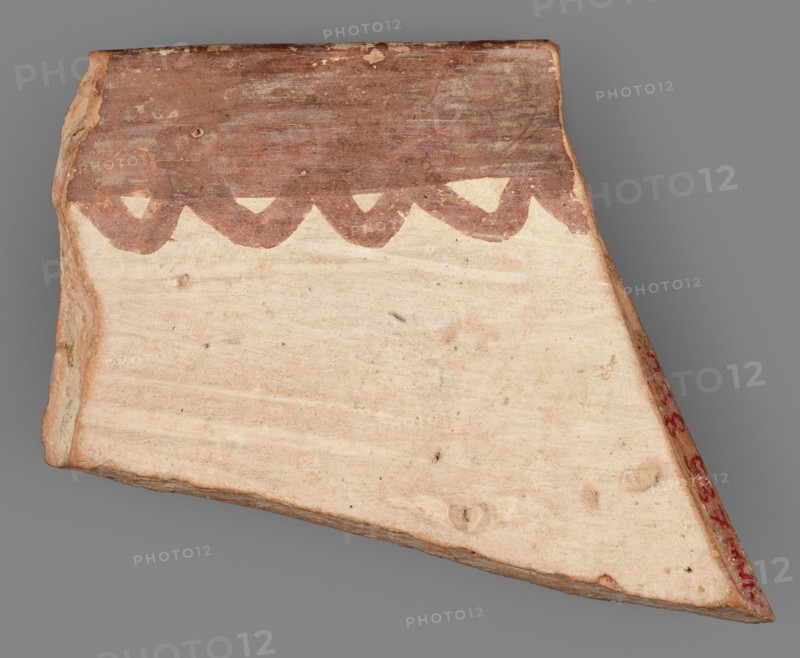
Fragment of a bowl, unknown Northern Mesopotamian workshop, painted pottery with geometric motifs, bowls, Eastern Gaulish Scenery. Fragment of the wall of a bowl or cup with a preserved pointed rim. On the outside, the decorative composition consists of from the top: a wide band of diagonally intersecting parallel lines, terminated at the bottom by a thick line. Below is a fragment of another band filled with a row of triangles or rhombuses filled with diagonally intersecting lines. On the inside, the decoration is limited only to the upper part of the vessel and consists of a wide band terminating at the bottom with a wavy line. c. 6500–c. 5500 BC; Halaf culture ca. 5200–ca. 4500 BC, Northern Mesopotamia Iraq/Syria/Turkey. Pottery fragment; height 3.8 cm, width 3.8 cm, depth 0.48 cm, weight 8 g., A fragment of a flat, triangular ceramic shard with a smooth, pale beige surface and a rougher, darker brown top edge that features a scalloped painted pattern; the shard shows worn, uneven edges and chipped areas with exposed terracotta tones, and there is a thin strip of faded red along one side; the background is a solid neutral gray.
Crédit
Photo12/Liszt Collection
Notre référence
LZT26A00_377
Licence
Droits gérés
Format disponible
19.2Mo (1.1Mo) / 24.2cm x 19.9cm / 2857 x 2351 (300dpi)