Légende
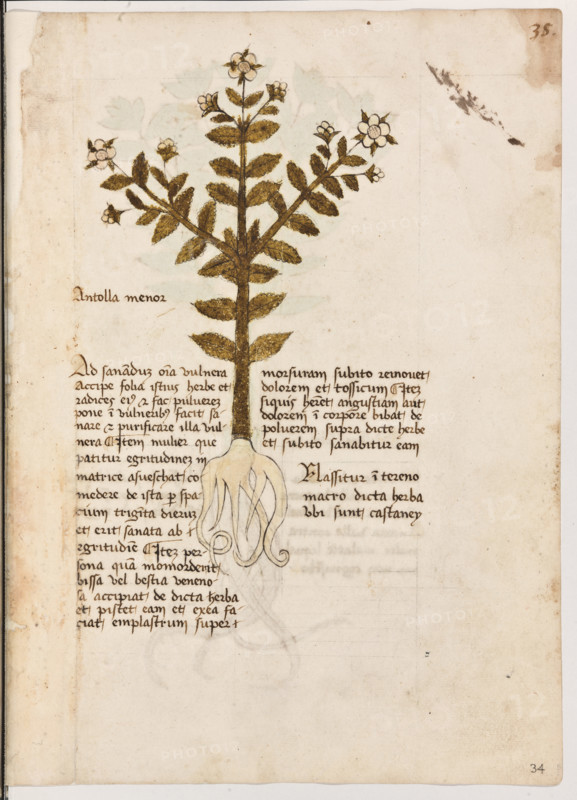
Erbario di Trento (Manoscritto n° 1591), XVI secolo, carta 34 recto: ”Antolla Menor”.
“Ad sanandum omnia vulnera, accipe folia
istius herbe et radices eius et fac pulverem;
pone in vulneribus: facit sanare et purificare
illa vulnera. Item mulier que patitur egritudi-
nem in matrice, asueschat comedere de ista
per spacium triginta dierum et erit sanata ab
egritudine. Item persona quam momorderit
bissa vel bestia venenosa, accipiat de dicta
herba et pistet eam et ex ea faciat emplastrum
super morsuram: subito removet dolorem et
tossicum. Item, si quis haberet angustiam aut
dolorem in corpore, bibat de polverem supra
dicte herbe et subito sanabitur eam.
Nassitur in tereno macro dicta herba ubi sunt
castaney.”
La traduzione è “Per sanare ogni ferita, prendi le foglie di quest’erba e le sue radici, fanne polvere e mettila nelle ferite: le fa guarire e purificare. Così una donna che soffre di disturbi dell’apparato genitale, continui a mangiare quest’erba per trenta giorni e guarirà dalla malattia. Inoltre chi venisse morsicato da una biscia o da un animale velenoso, prenda quest’erba, la pesti e ne faccia un impiastro sulla morsicatura: subito toglierà il dolore ed il veleno. Così, se qualche persona avesse un’indisposizione o un dolore nel corpo, beva la polvere della suddetta erba e subito guarirà. Quest’erba nasce nei terreni magri, dove vivono i castagni”.
[ENG]
Herbarium of Trento (Manuscript No. 1591), 16th century, page 34 recto: ”Antolla Menor”.
“To heal any wound, take the leaves of this herb and its roots, make a powder, and put it on the wounds: it heals and purifies them. Likewise, a woman suffering from genital disorders should continue to eat this herb for thirty days and will be cured of the disease. Furthermore, anyone bitten by a snake or a poisonous animal should take this herb, crush it, and make a poultice on the bite: it will immediately remove the pain and the poison. Likewise, if anyone has an indisposition or pain in the body, let them drink the powder of the aforementioned herb and they will immediately recover. This herb grows in poor soil, where chestnut trees grow.”
Museo provinciale d'arte - Caste, Trento (TN), Trentino Alto Adige - Südtirol, Italia - Italy
Date
16e siècle
Crédit
Ghigo Roli/Photo12
Notre référence
GHR26A02_212
Licence
Droits gérés
Format disponible
55.6Mo (4.7Mo) / 31.7cm x 43.9cm / 3744 x 5189 (300dpi)
Mots clés
Italy Trentino Alto Adige Südtirol Trento Culture Knowledge Book Ancient Book Herbarium Botany Plant Leaf 16th Century Root Herb Medicine Medical Herb Flower Manuscript Art Artwork Painting Drawing
Restrictions
Pour toute utilisation, il revient à l'utilisateur de s'assurer qu'il a toutes les autorisations nécessaires des entités représentant les artistes ou leurs ayants droit.