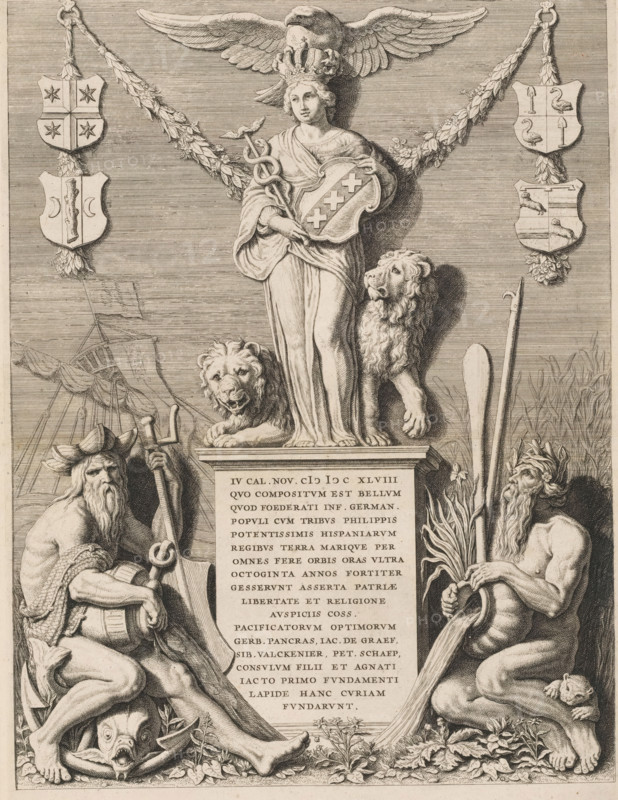
Caption
Sculpture group with the Amsterdam City Maiden, river gods, and inaugural text in the Courtroom of the City Hall on the Dam, print, book illustration, Sculpture group on the northern wall of the Courtroom in the City Hall on the Dam in Amsterdam. In the center, the Amsterdam City Maiden on a pedestal. On her head the imperial crown and an eagle, in her hands the coat of arms of the city and a caduceus, at her feet two lions. To her left the coats of arms of Gebrand Pancras (above) and Sybrant Valckenier (below), to her right the coats of arms of Jacob de Graeff (above) and Pieter Schaep (below). These four Amsterdam regents, all sons or nephews of the sitting mayors from the year 1648, laid the foundation stone of the city hall in that same year. On the pedestal the inaugural text, which refers to the Peace of Münster and the laying of the foundation stone. To the left of the pedestal is the river god (personification) of the IJ, with, among other things, a ship's crown, fishing net, anchor, and rudder. To the right is the river god (personification) of the Amstel, an oar, grappling hook, aquatic plants, and a beaver – which, as a dam-building animal, refers to the dam across the Amstel from which the city derives its name. The Vierschaar was a public court used by the bailiff and aldermen solely for pronouncing death sentences. Marked at the bottom center: F., printmaker: Hubert Quellinus, Amsterdam, after design by Hubert Quellinus, after sculpture by Artus Quellinus (I), publisher: Artus Quellinus (I), 1655, Hubert Quellinus, Artus Quellinus (I), printmaker, after sculpture by, publisher, paper, etching, engraving, height 442 mm x width 311 mm, A central crowned female figure stands on a plinth holding a shield and a staff entwined with a serpent, flanked by two lions at her feet and with an eagle with outstretched wings above her head; garlands hang from either side near de
Credit line
Photo12/Liszt Collection
Reference
LZT26B34_227
License type
Rights managed
Available size
51.3Mb (8.0Mb) / 12.4in x 16.1in / 3721 x 4818 (300dpi)