Caption
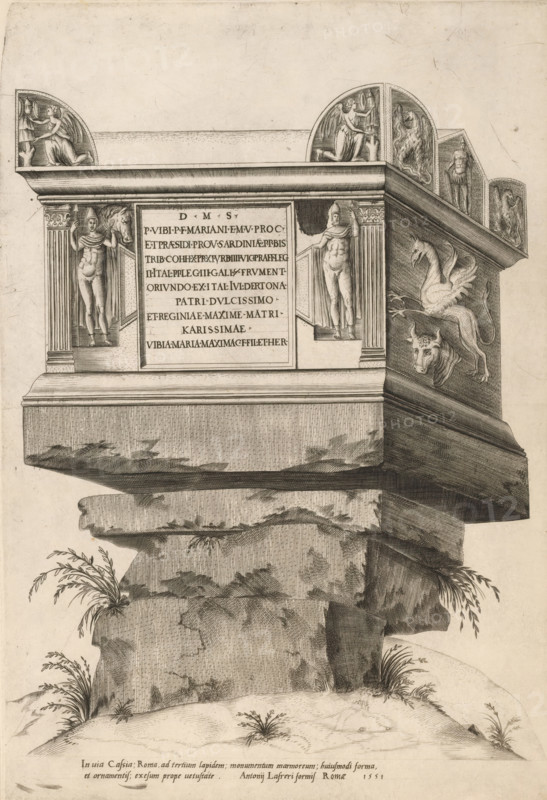
Tomb monument on the Via Cassia, Speculum Romanae Magnificentiae, print, album page, Roman tomb monument for Publius Vibius Marianus, also known as the Tomb of Nero, on the Via Cassia in Rome. A sarcophagus on a stack of large marble blocks. Print is part of an album., number: '76', number: '1', printmaker, publisher, Rome, Italy, paper, engraving, intaglio printmaking technique, height 455 mm x width 305 mm, This print belongs to the print corpus known as the 'Speculum Romanae Magnificentiae' ('Mirror of Roman Splendor'). This corpus, consisting of prints depicting artworks and buildings from ancient and modern Rome, originated with publishers Antonio Salamanca and Antonio Lafreri. These two foreign publishers joined forces in Rome during the period 1553–1563. Their prints soon became immensely popular among tourists and collectors, who purchased the prints individually or in large groups. Large groups of Speculum prints were often bound together in albums upon request. Several Speculum albums have survived, all differing in content. Between 1573 and 1577, Antonio Lafreri published a special title page (with the title 'Speculum Romanae Magnificentiae') that people could add to their collections. Lafreri's death in 1577 did not mark the end of the corpus. A large portion of the copper plates passed to Claudio and Stefano Duchetti. The remainder was dispersed among various other publishers. The popularity of the Speculum prints continued to inspire publishers for a considerable period to commission copies and add new prints to the corpus., A stone funerary monument sits atop a rocky outcrop with patches of grass and small plants around its base, the monument showing a rectangular central plaque inset between fluted pilasters and flanked by standing male figures in draped garments, a decorative cornice above, and semicircular relief panels along the top edge depicting kneeling winged figures and other carved scenes; one side panel shows a winged creature with a hors
Credit line
Photo12/Liszt Collection
Reference
LZT26B31_116
License type
Rights managed
Available size
53.6Mb (7.6Mb) / 11.9in x 17.5in / 3581 x 5236 (300dpi)