Caption
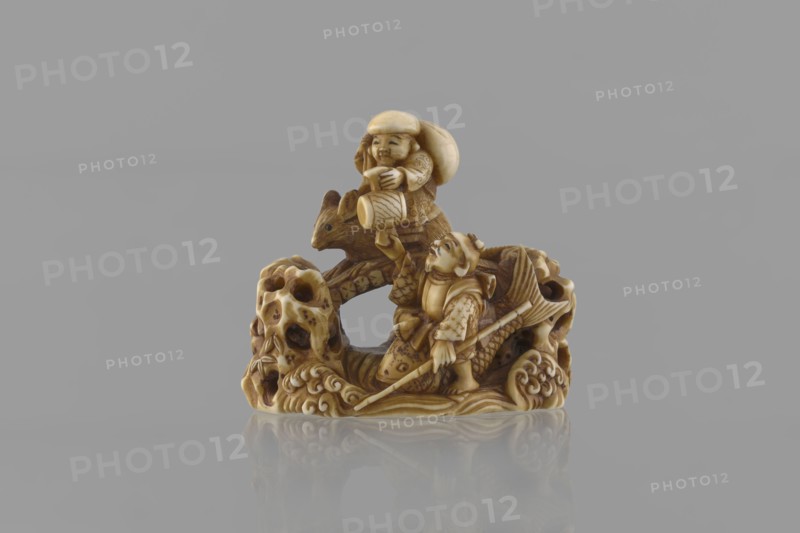
Netsuke in the shape of Daikoku and Ebisu, Ryôji fl. ca. 1886–1900? sculptor; author unknown. Japanese, Meiji period 1868–1912. Carved miniature netsuke katabori depicting Daikoku and Ebisu from the Seven Gods of Good Fortune: Daikoku sits on a rat holding a hammer in his left hand with a bag on his back; Ebisu holds a fishing rod and rides a giant fish. Finely carved in a miniature rocky landscape with a bridge, showing detailed facial features, fish scales, bamboo leaves on openwork rocks, rat fur, and rat’s eyes set with microscopic black-dyed bone inlays. 4th quarter of the 19th century, Japan. Height 3.9 cm; width 4.0 cm., A small carved ivory-colored figurine depicts a scene with a few humanlike figures and an animal on an ornately textured base; the carving shows a standing figure holding a long pole and wearing patterned clothing, a second seated figure above holding a rounded object, and an animal with pointed ears nestled between them, all carved with detailed patterns, scales, and facial features. The base is carved with swirling wave-like forms and porous rock-like structures, and the piece sits on a reflective surface that mirrors its shapes. The visible colors are beige, tan, cream, brown, and touches of darker brown in the carved recesses, set against a plain gray background.
Credit line
Photo12/Liszt Collection
Reference
LZT26A24_080
License type
Rights managed
Available size
43.6Mb (610.1Kb) / 15.9in x 10.6in / 4778 x 3186 (300dpi)