Caption
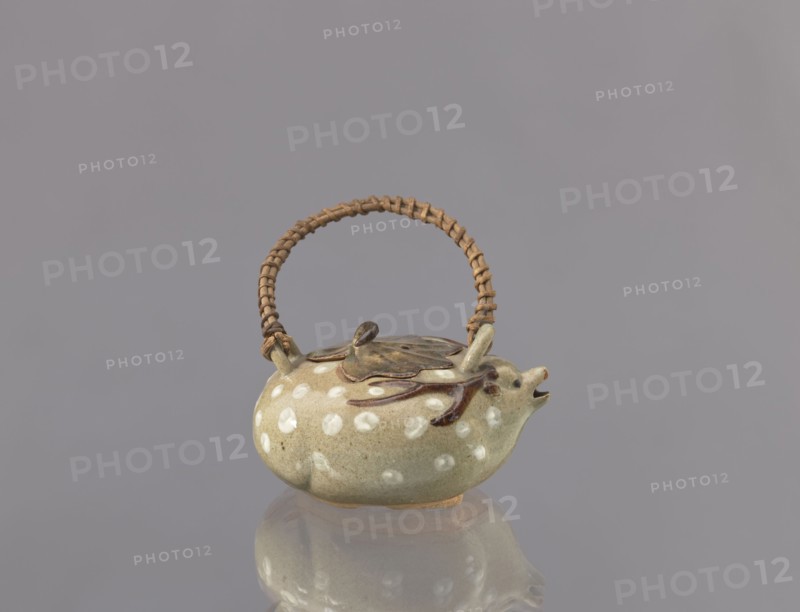
Sake jug chôshi with lid. Yellowish clay covered with grayish glaze; woven wicker handle. Decorated with animals deer with antlers, maples and leaves. Function: for alcohol/sake. Meiji period, late 19th century 1868–1912., Place of origin: Harima, Japan. Height 8 cm; width 12 cm; diameter 10.5 cm; weight 0.24 kg., A small ceramic teapot shaped like an animal sits on a reflective surface against a muted gray background; the teapot is pale greenish-beige with a pattern of several white spots, a darker brown spout forming the animal's open mouth, and a brown applied lid detail resembling a leaf, and it has a curved woven handle in light and medium brown tones.
Credit line
Photo12/Liszt Collection
Reference
LZT26A22_361
License type
Rights managed
Available size
78.8Mb (1.3Mb) / 20.0in x 15.3in / 6000 x 4591 (300dpi)