Caption
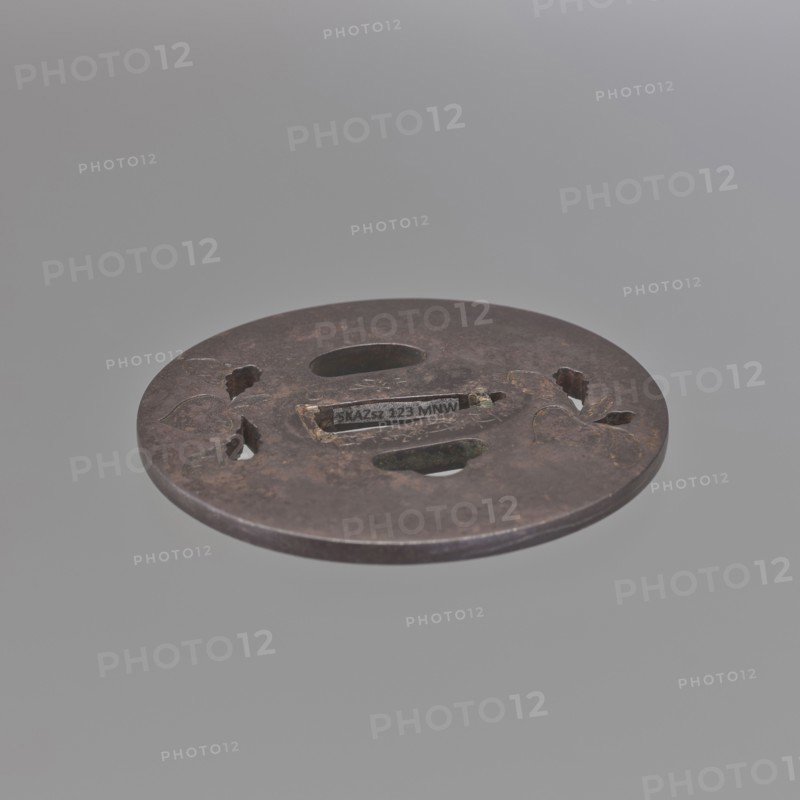
Crossguard tsuba, Masahide; Bushû school. Oval tsuba tatemaru gata with rectangular edge kaku mimi. Decorated on both sides in recessed relief and partially openwork leaves with a radish motif — one of the attributes of Daikoku, the god of happiness. 18th century Edo period, 1603–1868. Made in Asakusa, Edo now Tokyo, Japan. Material for katana; height 7.7 cm, width 7.3 cm, depth 0.35 cm., A circular, flat metal object with a worn, dark brown and rusty surface floats against a plain light gray background; the object has several rounded and irregular cutouts and carved shapes around its center, with areas showing darker brown, black, and hints of greenish corrosion, and a few small patches where the metal appears slightly lighter or more polished.
Credit line
Photo12/Liszt Collection
Reference
LZT26A21_059
License type
Rights managed
Available size
103.0Mb (2.8Mb) / 20.0in x 20.0in / 6000 x 6000 (300dpi)