Caption
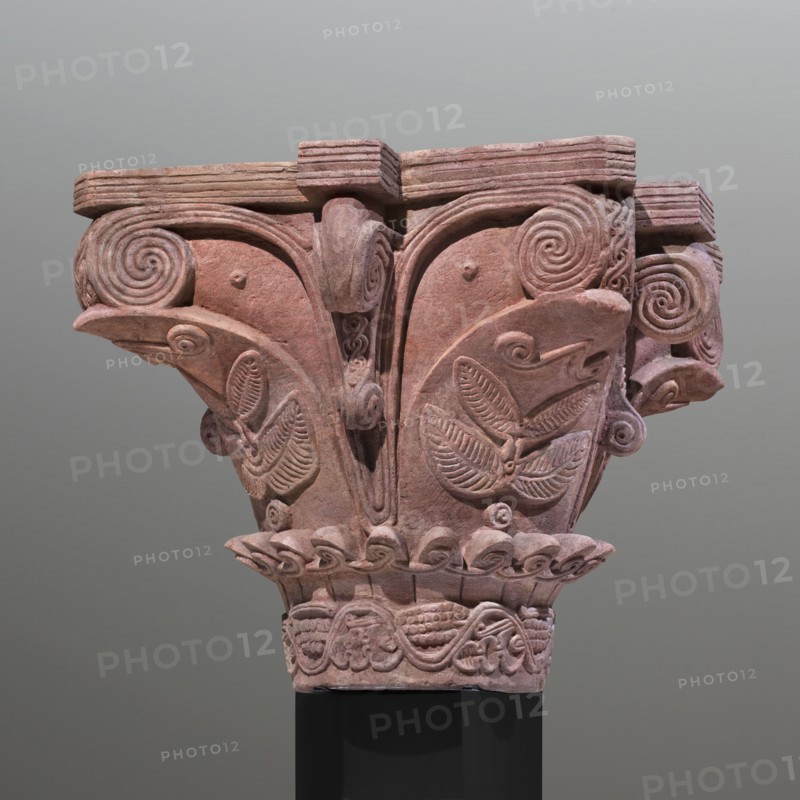
Upper and lower fragments of the capital reconstructed to their complete form. Nubian workshop. Architectural element; capital preserved in two fragments, reconstructed to its complete form. The high neck is decorated with a wavy vine twig with stylized leaves at the bottom and clusters at the top in an alternating arrangement. Above the neck, the shaft is decorated with a wreath of small plastic leaves adorned with small loops of ribbon. The shaft is decorated with large, wide, smooth leaves. On their surface, branches with symmetrically arranged leaves and marked veins are depicted in relief. Between the wide leaves are ribbons arranged in a V-shape, forming volutes at the top. Decorative, plastic elements in an S-shape emerge from between the ribbons, forming supports for the abacus's protrusions. The abacus is low, divided into three layers by two engraved lines. Large capitals of this type were part of the decor of the older basilica and topped the columns of the main nave; pairs of capitals had identical decoration. During the expansion of the older church, they were used as building material in the northeastern corner of the cathedral. 2nd half of the 6th–1st quarter of the 7th century. Faras. Architectural element. Height 30 cm; width 57 cm., A carved stone capital with a pinkish color sits against a neutral gray background, showing a symmetrical design with swirling volutes at the top corners, curved leaf-like forms on the faces, and a band of carved, rounded motifs near the base; the stone surface has textured grooves and tool marks, and the piece rests on a dark pedestal.
Credit line
Photo12/Liszt Collection
Reference
LZT26A06_219
License type
Rights managed
Available size
103.0Mb (5.7Mb) / 20.0in x 20.0in / 6000 x 6000 (300dpi)