Caption
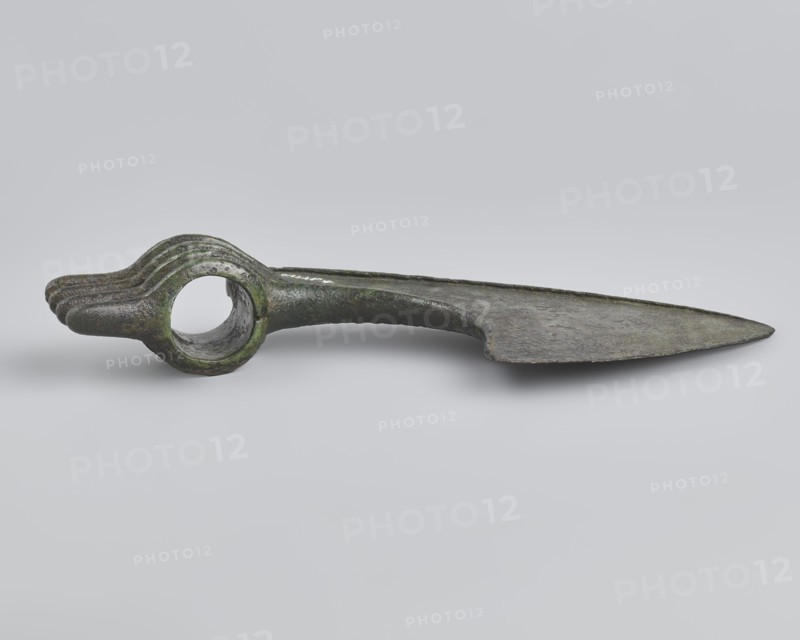
Battle axe, unknown Luristan workshop. Battle axe with a low cylindrical socket with a round hole, from which grows a blade terminating in a semicircular cutting edge set at about 45° to the shaft axis. The base of the blade protrudes above the socket; its upper edge is sloping and straight with a slight central bulge, the lower edge is shorter and slightly obtuse-arched. Four identical blunt-tipped spikes protrude from the butt, connected vertically at mid-length; the spikes extend into side ribs on both sides of the socket — the upper two terminate at the base of the blade, the third extends into its lower edge, and the fourth runs around the lower edge of the socket for reinforcement. Luristan, Iran; 2nd half of the 2nd millennium BC. Bronze weapon. Weight 334 g; height 10.2 cm; length 19 cm; thickness 3.2 cm., A metal object with a long flat blade-like section tapering to a pointed end lies horizontally on a pale gray background; the opposite end forms a rounded ring with a hollow center and layered ridges extending outward, and the surface shows a weathered, rough texture with patches of greenish patina and darker brownish-gray metal tones.
Credit line
Photo12/Liszt Collection
Reference
LZT26A06_005
License type
Rights managed
Available size
57.2Mb (856.2Kb) / 16.7in x 13.3in / 5000 x 4000 (300dpi)