Caption
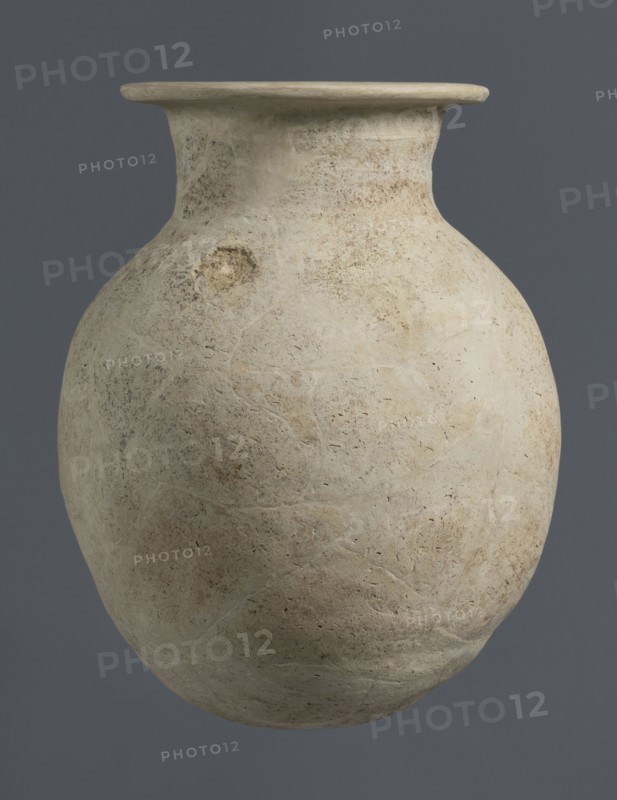
Vise-less jug, unknown northern Mesopotamian workshop. Early Jazira III / Early Dynastic III period, ca. 2600–2350 BC. Clay vessel: vise-less jug with an ovoid belly, flat crookedly cut round bottom, sloping shoulders rising to a high cylindrical neck terminating in a wide flat spout protruding outwards. Bulbous vessel; jug. Origin: Northern Mesopotamia Khabur basin, Al-Jazira. Found at Tell Rad Shakra northeastern Syria., A large rounded clay vessel with a wide flared rim sits against a solid dark gray background. The vessel's surface is a pale beige to off-white with areas of light brown and faint tan discoloration, showing a textured, slightly pitted and weathered finish. There are visible repaired seams and subtle irregularities in shape, including a rough circular patch on one side. The rim is smoother and lighter in tone than the body, and the overall appearance is matte with small speckles and faint mottling of beige, tan, and light brown.
Credit line
Photo12/Liszt Collection
Reference
LZT26A05_337
License type
Rights managed
Available size
79.5Mb (6.0Mb) / 15.4in x 20.0in / 4633 x 6000 (300dpi)