Caption
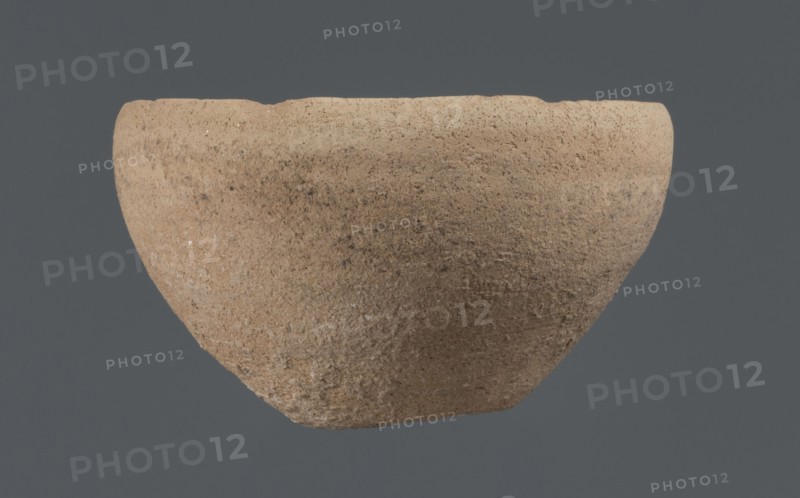
Bowl, unknown Northern Mesopotamian workshop, Early Jazira III period ca. 2600–ca. 2350 BC. Clay vessel tableware. Bowl with a flat, obliquely cut round bottom, gently sloping walls that straighten in the upper part and bend slightly inward, ending in a straight, non-distinctive rim. Before firing, a potter's mark was engraved at the bottom as two intersecting lines of differing lengths: a shorter line parallel to the bottom and a longer line starting at the belly and reaching half the bottom diameter. Origin: Northern Mesopotamia Khabur basin, Tell Rad Shakra, Northeastern Syria., A roughly bowl-shaped object with a coarse, textured surface in shades of tan, beige, and light brown suspended against a flat dark gray background; the rim is uneven and the body shows mottled darker brown speckles and small lighter flecks across its surface.
Credit line
Photo12/Liszt Collection
Reference
LZT26A05_263
License type
Rights managed
Available size
63.7Mb (5.0Mb) / 19.9in x 12.4in / 5980 x 3723 (300dpi)