Caption
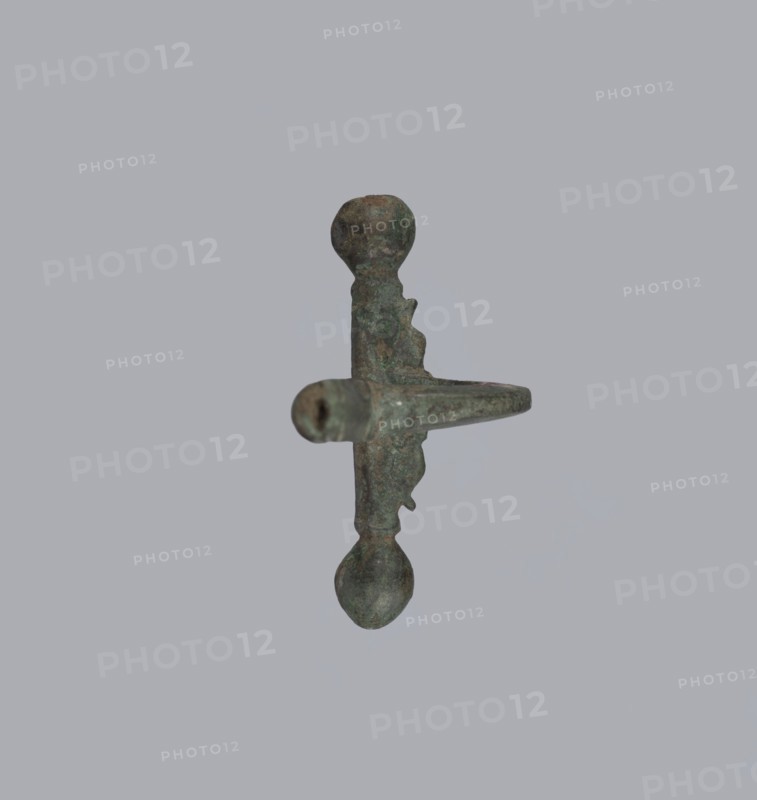
Onion-shaped fibula, Italy; bronze fibula with hinged structure: an arched ring formed from a quadrilateral plate, one end terminating in a thick transverse plate with a stepped upper edge and large balls on both sides, the other ending in a thick sheath shaped as a half-cylinder, cut to receive a needle. Condition: good, surface with greenish corrosion and brown spots. Date: late 3rd–4th century; probable origin: Rome. Jewelry, fibula., A single metal object is centered against a plain light gray background, showing a vertical shaft with rounded knobs at both ends and a horizontal protruding arm; the object has a weathered, mottled surface with greenish patina and areas of brown and dark gray, and irregular textured edges and pitted spots are visible along its form.
Credit line
Photo12/Liszt Collection
Reference
LZT26A05_087
License type
Rights managed
Available size
97.4Mb (824.5Kb) / 18.9in x 20.0in / 5675 x 6000 (300dpi)