Caption
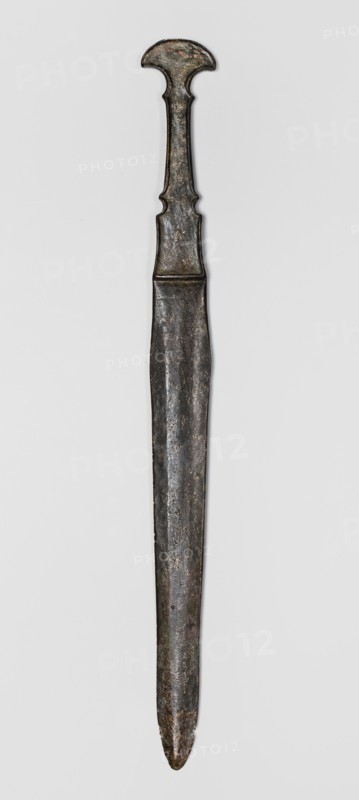
Dagger, unknown Luristan workshop. Dagger with a cast blade and a mushroom-shaped hilt with a rimmed mount; the raised edges of the mount served to hold a lost hilt casing possibly bone, wood, horn, or stone. The hilt shaft is richly profiled and flows directly into the blade with a centric point. Behind the short, rectangular base, blunted on both sides, the double-edged blade tapers evenly towards the tip. A slightly convex ridge runs through the center of the blade, which splits along one-third of its length towards the base, creating a triangular flat field. 9th–6th century BC; Iron Period II 1st half of the 1st millennium BC. Luristan, Iran. Weapon. Height 33.8 cm; width 2.9 cm; depth 0.8 cm; weight 194 g., A single elongated metal object with a narrow pointed end and a wider decorative top, shown against a light background; the object has a long straight shaft that tapers slightly toward the tip and displays an uneven, textured surface with signs of wear; the upper portion features a short section with subtle ridges transitioning to a longer handle area that flares into a rounded, double-lobed head; visible colors include dark gray, brownish bronze, and hints of dull green and lighter metallic highlights.
Credit line
Photo12/Liszt Collection
Reference
LZT26A04_309
License type
Rights managed
Available size
46.2Mb (1.2Mb) / 9.0in x 20.0in / 2693 x 6000 (300dpi)