Caption
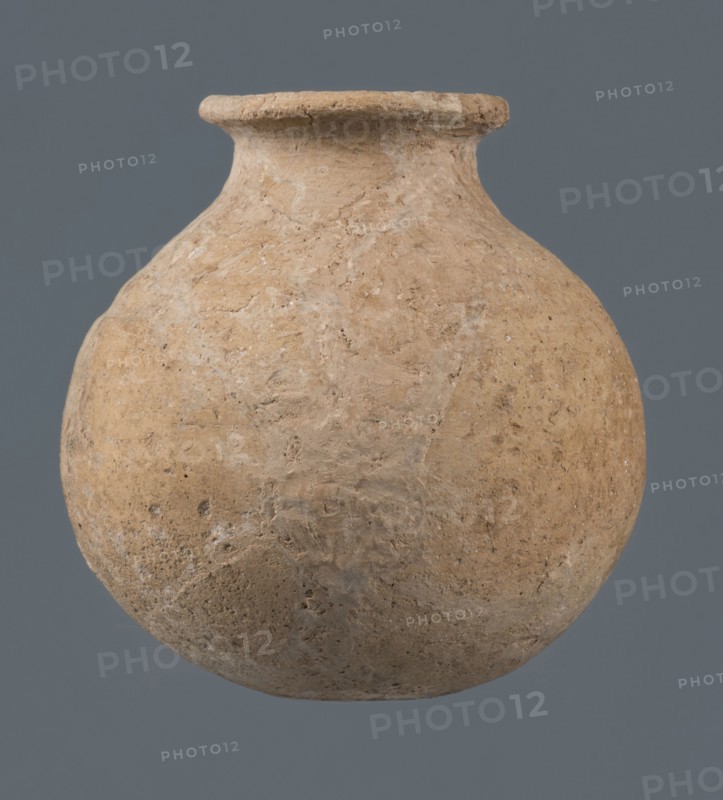
Globular vessel, unknown Northern Mesopotamian workshop, Early Jazira III period ca. 2600–ca. 2350 BC Early Dynastic III period. A globular vessel whose body rises to three-quarters height into sloping arms, from which a low narrow neck arises, terminating in a thickened, flared rim. The transition from body to arms is emphasized by a shallow, wide horizontal groove. Circa 2600–ca. 2350 BC. Origin: Northern Mesopotamia Khabur basin, Tell Jassa el Gharbi, northeastern Syria. Function: vessel for oils and ointments; vice-free vessel. Material/type: vessel; height 10 cm, width 9.7 cm., A rounded, bulbous clay vessel with a short neck and flared rim sits centered against a solid muted gray background; the vessel surface is rough and textured with an uneven, weathered appearance showing a mix of beige, tan, light brown, and pale gray tones.
Credit line
Photo12/Liszt Collection
Reference
LZT26A03_474
License type
Rights managed
Available size
88.7Mb (6.5Mb) / 17.7in x 19.5in / 5297 x 5856 (300dpi)