Caption
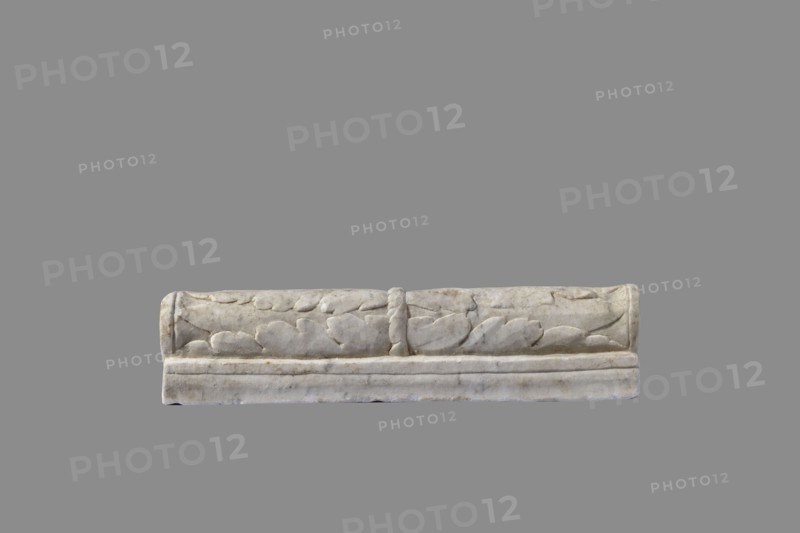
Urn with a depiction of swans, unknown Roman workshop. Urn with sepulchral funerary function, Roman, dated to the 2nd half of the 1st century AD probably 3rd quarter of the 1st century AD; Roman Empire 27 BC–476, findplace: Rome. Weight 45.5 kg. Main plate: The urn's box is trapezoidal, tapering toward the top, placed on a profiled base. The front decoration is sparse; the main surface is occupied by a tabula ansata whose ears are decorated with palmettes. Below the inscription field are two swans in deep relief, facing each other with strongly arched necks, appearing to take flight with outstretched wings touching the inscription frame. The upper part is crowned by a profiled cornice. On the inner upper edge a rectangular protrusion for securing the lid is visible. Side walls: no decoration. Metal pins visible under the cornice on both sides. Lid: original missing., A horizontal stone object with carved rounded leaf-like shapes along its front surface, showing a central raised vertical band and a lower rectangular base; the stone appears weathered with smooth worn edges and surface irregularities. The visible colors are shades of gray, off-white, and light beige, with subtle darker spots and slight brownish discoloration in places. The background is a uniform medium gray.
Credit line
Photo12/Liszt Collection
Reference
LZT26A03_374
License type
Rights managed
Available size
68.7Mb (1.1Mb) / 20.0in x 13.3in / 6000 x 4000 (300dpi)