Caption
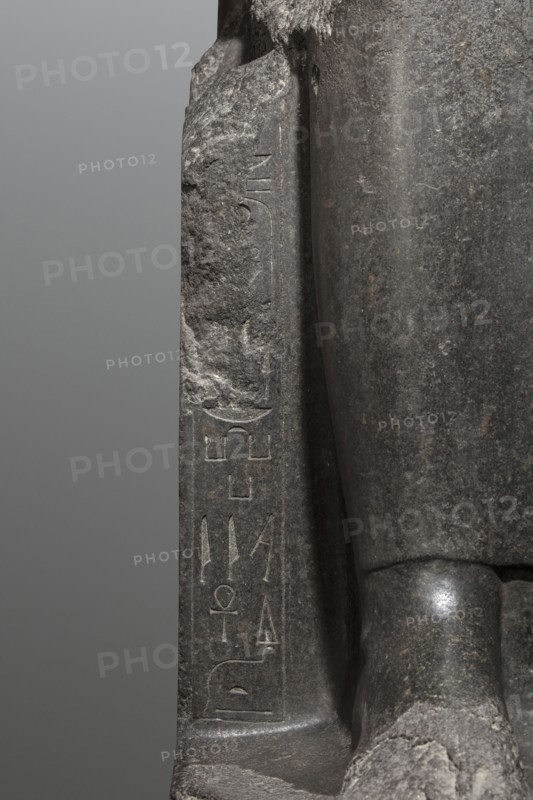
Statue of the goddess Sekhmet, Sekhmet mythology, solar discs, uraei, hieroglyphs, thrones, lionesses, Egyptian deities. Woman with a lioness's head seated on a throne, dressed in a long, close-fitting veil. Hands placed on her knees; in her left hand the goddess holds the sign of life. At the front of the throne, next to the goddess's legs, a column of hieroglyphs on each side. On the sides of the throne is carved a sema taui motif. c. 1390–1352 BC; New Kingdom, 18th Dynasty reign of Amenhotep III, found at Karnak. Sculpture; height 240 cm, width 61 cm, depth 123 cm, weight 2300 kg., A close-up view of a dark gray stone sculpture showing a section of a carved figure seated on a base, with a flat vertical slab beside the figure. The stone surface displays a range of gray tones from light to dark, with rough weathered textures and smoother polished areas. The seated figure's knee and part of the lower leg are visible, rounded and smoother with subtle highlights, while the adjacent slab has incised linear shapes and shallow carved grooves that appear in similar gray shades. The left edge of the slab is more irregular and rough, with lighter gray worn patches, and the base shows a curved transition between surfaces. The background at left is a uniform mid gray.
Credit line
Photo12/Liszt Collection
Reference
LZT26A03_221
License type
Rights managed
Available size
68.7Mb (4.4Mb) / 13.3in x 20.0in / 4000 x 6000 (300dpi)