Caption
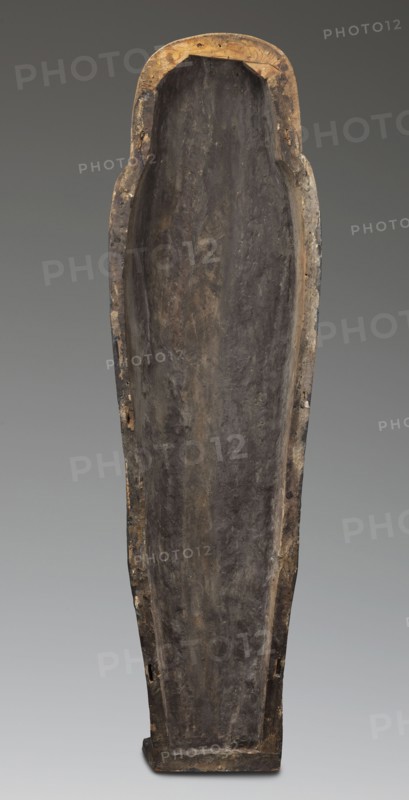
Lid of the sarcophagus of a man named Setau, Setau ca. 1479–1295 BC. Sacrificial formulas; depiction of the goddess Nut; hieroglyphs. A vertical band of inscription runs through the center – the sacrificial formula. Two columns of text along the edge of the lid and three columns of inscription running across the lid divide the surface into six fields. The legs are clearly defined, the arms are modeled, the hands are clenched. On the chest is a richly polychrome seven-row necklace. Below the hand is a depiction of the winged goddess Nut. The head is sculpturally detailed: face painted red with large almond-shaped eyes set slightly obliquely; eyeballs clearly defined; pupils and eyebrows highlighted with black paint; straight, strongly flattened nose; small mouth with wide, full lips. The wig is schematically decorated with yellow stripes. Setau once had a thin, curved beard visible in a pre-war photo. c. 1479–c. 1295 BC; New Kingdom, late 18th Dynasty, Deir el-Medina tomb 1352, western necropolis. Sarcophagus lid; height 192 cm, width 50 cm, depth 34 cm., A tall, narrow, coffin-shaped wooden form viewed from above showing its hollow interior, with a weathered surface that displays dark gray and brown tones and lighter areas of tan and beige along the rim and edges; the interior surface appears rough and uneven with varied patches of darker gray and brown, while the outer rim shows worn wood grain in tan and light brown with some darker discoloration, and the background is a smooth gradient of medium gray.
Credit line
Photo12/Liszt Collection
Reference
LZT26A03_189
License type
Rights managed
Available size
52.8Mb (2.6Mb) / 10.2in x 20.0in / 3074 x 6000 (300dpi)