Caption
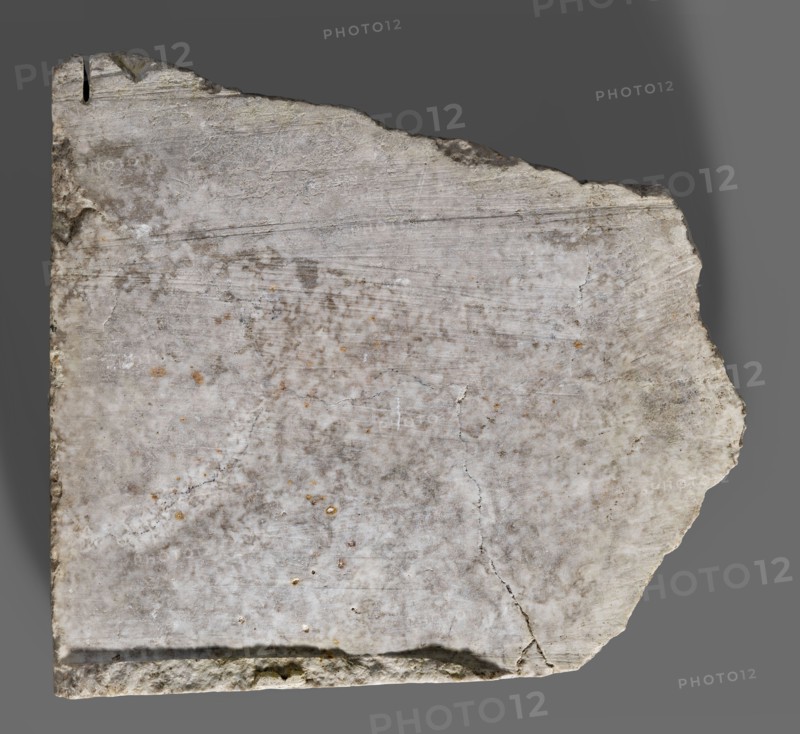
Fragment of an orthostat with relief decoration, unknown Neo-Assyrian workshop. Fragment of a stone wall-cladding slab orthostat with a relief representation of a man shooting a bow. The realistically carved horse head, with a trimmed mane and a low horseshoe-shaped plume on top, features a meticulously rendered bridle. The rider, shown in left profile, holds a drawn bow with an arrow in his left hand and wears a helmet. As is customary, the eye is shown full face. The long beard and mustache are schematic and give the impression of being unfinished. In the upper left corner, traces of an inscription having been chiseled off are visible, and similar traces appear between the bow and the rider's head, indicating the slab's secondary use. Neo-Assyrian art, 7th century BC c. 668–c. 631 BC, reign of Ashurbanipal. From the South-Western Palace Kuyunjik/ancient Nineveh, orthostat; height 28 cm, width 32 cm, depth 7.8 cm, weight 10.6 kg., A roughly rectangular stone slab with an irregular broken edge, showing a weathered, pitted surface in shades of light gray and off-white with patches of darker gray. The slab has subtle streaks and scratches across its face and a few small rounded pits with rusty brown and ochre flecks. The edges reveal rougher, darker gray and beige tones, with one corner showing a pronounced chip. The background behind the slab is a uniform mid to dark gray.
Credit line
Photo12/Liszt Collection
Reference
LZT26A03_052
License type
Rights managed
Available size
94.5Mb (7.2Mb) / 20.0in x 18.4in / 6000 x 5507 (300dpi)