Caption
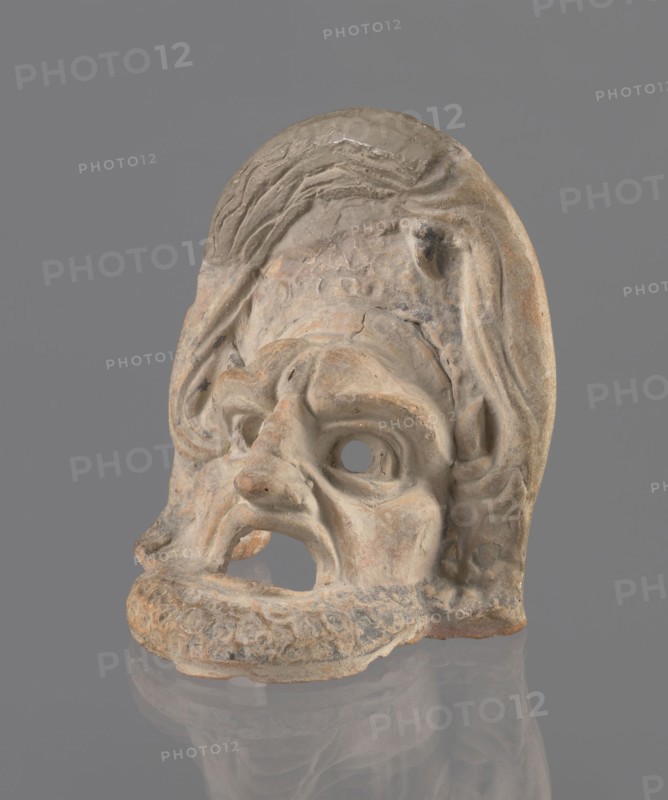
Tragic mask, terracotta, tragic/theater mask. Tragic mask depicting a male face, likely a decorative element antefix?. The lower part with the beard underside edges flat is set at a near-perpendicular angle to the facial part and forms the base. Realistic theatre-mask features: protruding cheekbones, deep furrows around mouth and eyes; mouth wide open, lower lip almost horizontal, upper lip arched. Large, deep-set eyeballs have circular cut-out holes, positioned at slightly different heights right higher than left. Slightly hooked nose with horizontal wrinkles; thick eyebrows; vertical wrinkles at center of forehead; convex forehead. Above the forehead is a flat, high onkos with schematically marked locks of hair, bounded at top and sides by folds of cloth. Light orange clay, unevenly fired at the fracture turning red. Traces of polychrome—red, on the cheek, black, on the beard and hair. Upper right part above the forehead has been reconstructed. 4th–3rd century BC, Southern Italy; mask., A worn sculpted mask fragment showing a stylized human face with a prominent forehead, deep-set eye sockets with holes, a pronounced nose, furrowed brows, an open mouth, and a textured beard; the surface shows chips, cracks, and layered contours; colors visible include shades of beige, tan, light brown, gray, and hints of reddish-brown, all set against a solid gray background with a subtle reflective surface beneath the object.
Credit line
Photo12/Liszt Collection
Reference
LZT26A02_463
License type
Rights managed
Available size
85.3Mb (2.3Mb) / 16.6in x 19.9in / 4988 x 5974 (300dpi)