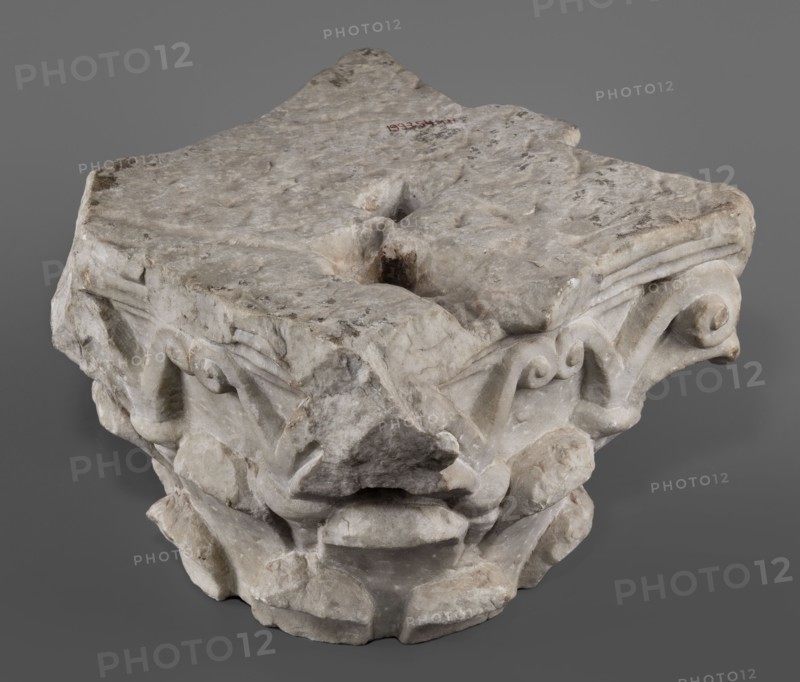
Caption
Corinthian capital, Corinthian capital composed of a calathos and thick stems that bifurcate and terminate in volutes supporting the abacus. The crown of leaves, formed by two rows of eight full leaves, occupies half the height of the capital. The leaves are rounded and angled outward. Thick caules with lacings in the form of thick rings grow from the upper row. The volute stems are in the form of flat ribbons. The outer volutes are significantly larger than the inner ones, meeting directly under the projection of the abacus rosette. The abacus is profiled, two-part with extended corners. Two corners, including the volutes, are upholstered. The edges of the leaves are chipped. 4th–5th century late antique period, Roman Empire; architectural element / capital; materials: Roman architecture ornamentation with acanthus leaves; height 24 cm, width 34 cm, depth 33 cm, weight 42.5 kg., An off-white carved stone fragment with areas of gray and beige discoloration sits against a neutral gray background; the stone has a rough, weathered top surface with a central hollow and chipped edges, while its sides display carved scroll-like motifs and rounded, layered forms with smooth and rough textures, and there are a few darker brown spots and subtle shadowed recesses in the carved areas.
Credit line
Photo12/Liszt Collection
Reference
LZT26A02_445
License type
Rights managed
Available size
87.9Mb (5.0Mb) / 20.0in x 17.1in / 6000 x 5118 (300dpi)