Caption
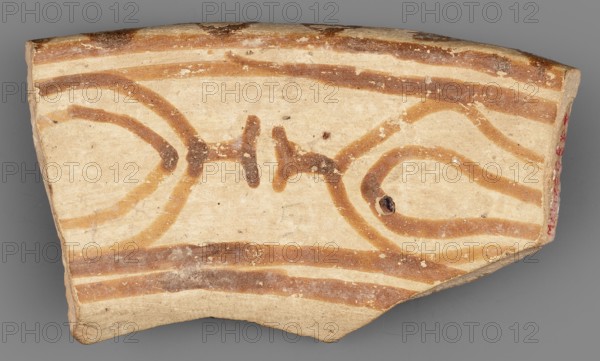
Fragment of a bowl, unknown northern Mesopotamian workshop; bucranium ornament; painted pottery with geometric ornaments; Eastern Gaulish Scenery; Upper fragment of the bowl wall with the preserved rim and geometric decoration painted on both sides. On the outer side, a simple geometric ornament consists of two parallel red bands of different widths, separated by an empty stripe on a cream-colored background. On the inner side, in a band bounded by horizontal lines, are two highly schematic, linearly stylized bucraniums bull heads with horns, arranged base to base. The narrow rim is decorated with painted, irregularly rounded triangles, their bases resting on the outer edge. The painted decoration was made before firing, from carefully polished ferrous clay, applied to a dry and very smooth layer of glaze that covered the vessel's surface. After firing, the painting acquired a color ranging from red to dark brown, while the glossy background is cream-colored. Ca. 6500–5500 BC; Halaf culture, Northern Mesopotamia Iraq/Syria/Turkey; pottery fragment; weight 16 g., A broken, flat fragment of pottery with a light beige background and a pattern painted in brown; the pattern consists of flowing curved lines and a central angular motif, with several concentric curved bands near the edges and a few small darker spots and areas of surface wear; the broken edges show rough, unglazed beige interior and a small area with a hint of red on one side; the overall colors visible are beige, brown, dark brown, and a small touch of red, set against a neutral gray backdrop.
Credit line
Photo12/Liszt Collection
Reference
LZT26A00_368
License type
Rights managed
Available size
27.7Mb (2.4Mb) / 13.4in x 8.0in / 4010 x 2414 (300dpi)